Researchers Develop High-Entropy Cathode for Sodium-Ion Batteries
06/09/2026 / By Edison Reed
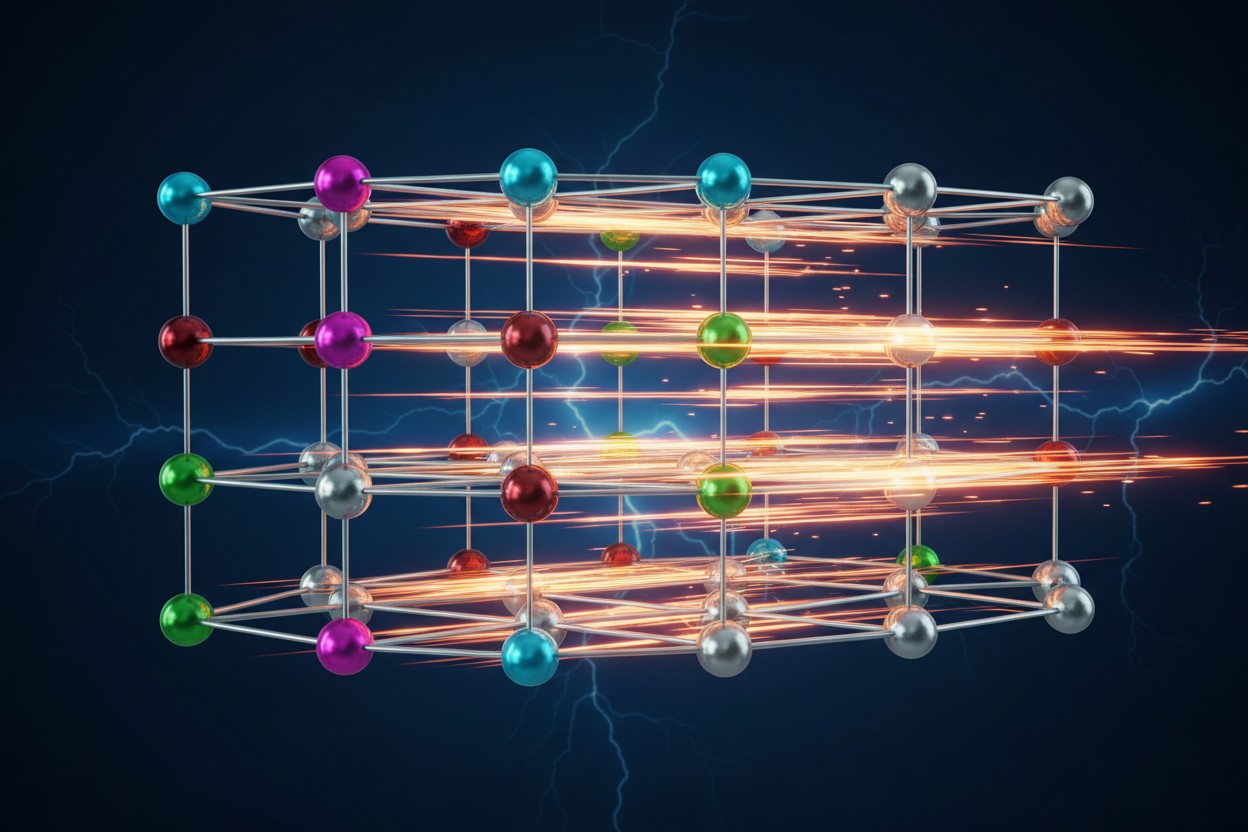
A team of scientists from India and the United States has designed a new cathode material for sodium-ion batteries that demonstrates fast charging, structural stability, and strong capacity retention, according to a report published by SodiumBatteryHub. The cathode uses five transition metals arranged in a highly disordered atomic structure, a design known as a high-entropy configuration. [1]
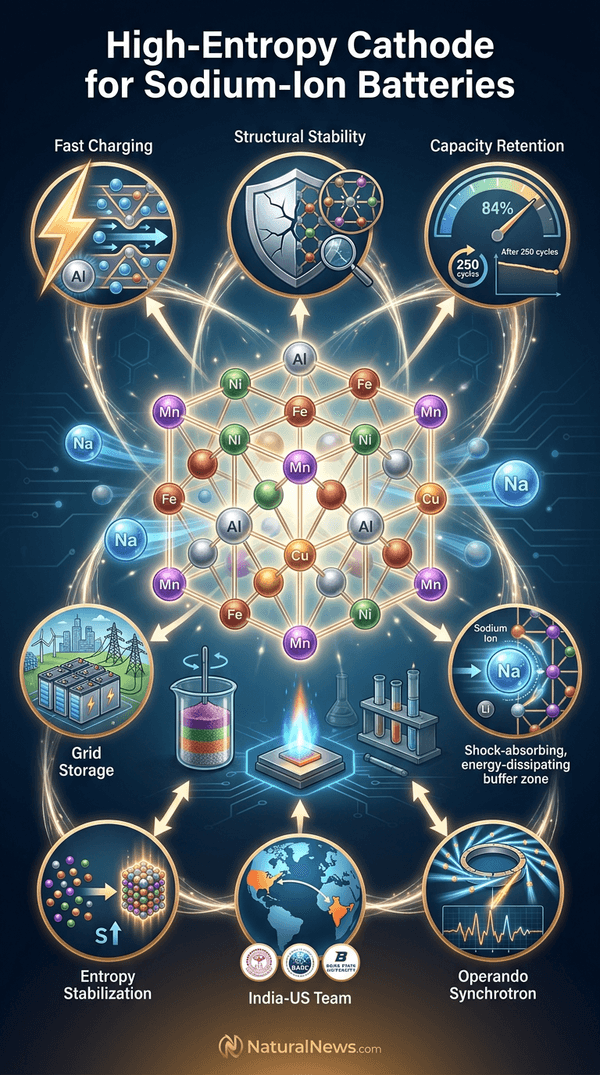
In testing, the cathode retained nearly 84 percent of its capacity after 250 rapid charge-discharge cycles, the report stated. The material kept a stable hexagonal structure during operation, avoiding common degradation mechanisms. The work aims to improve sodium-ion batteries for grid-scale renewable energy storage, where cost and durability are critical factors. [1] The research adds momentum to a global push for inexpensive and safe battery chemistry that does not rely on scarce or conflict-ridden minerals. [2]
Research Team and Methods
The research team included scientists from IIT Indore, the Bhabha Atomic Research Centre, IIT Mandi, and Boise State University, according to the report. [1] They focused on the cathode, a key battery component that determines energy capacity and cycle life. Instead of using only one or two metals, the team combined manganese, iron, nickel, copper, and aluminum in a precise ratio to create a high-entropy material with a disordered crystal lattice. [1]
To observe how the material behaved during operation, the researchers used operando Synchrotron X-ray diffraction, a technique that monitors atomic-level changes in real time while the battery charges and discharges. [1] This method allowed them to track how the crystal structure responded under stress. The team reported that the material maintained its hexagonal form throughout cycling, avoiding phase shifts that often degrade performance in layered cathodes. [1] The study builds on decades of research into layered oxide materials for sodium batteries. [3]
How the High-Entropy Material Works
The high-entropy configuration creates a stable atomic framework that resists structural changes during battery operation, according to the report. [1] In a high-entropy material, five or more elements share a crystal lattice in near-equal proportions, introducing disorder that can improve mechanical and electrochemical properties. In this case, the mix of five transition metals locks the crystal into a strong solid form that does not easily shift between phases. [1]
Aluminum plays a specific role in enhancing performance. The report stated that aluminum atoms expand the spacing between atomic layers, which facilitates faster movement of sodium ions through the cathode. [1] The wider channels reduce resistance and allow the battery to charge and discharge at higher rates. The combination of structural disorder and expanded spacing produces a cathode that combines speed, durability, and energy storage. [1] Research labs around the world are working to improve the specific energy, lifetime, and safety of batteries through similar cathode engineering. [4]
Performance Data and Results
The cathode provided a high initial capacity and retained approximately 84 percent of that capacity after 250 rapid cycles, according to the report. [1] Fast cycling puts additional stress on battery materials, so maintaining most of the capacity under those conditions indicates strong durability. The material also preserved its stable hexagonal structure throughout operation, which the researchers said helps maintain smooth ion transport and prevents the capacity fade seen in many layered cathodes. [1]
The design balances speed, durability, and energy storage, according to the researchers. [1] While specific energy density figures were not provided in the report, the retention rate and structural stability suggest the cathode could meet the requirements for grid storage applications where long cycle life and low cost matter more than maximum energy density. The study demonstrates that atomic-level engineering can enhance battery performance without adding manufacturing complexity. [1] The energy density of sodium-ion batteries has been a limitation compared to lithium-ion, but recent breakthroughs are closing the gap. [5]
Implications for Grid Storage and Clean Energy
Sodium is abundant and inexpensive compared to lithium, making sodium-ion batteries attractive for large-scale renewable energy storage, according to multiple sources. [6] The United States holds about 92 percent of global sodium carbonate reserves, which could reduce reliance on foreign supply chains. [7] Power grids require low-cost batteries that can store solar and wind energy for use when the sun is not shining or the wind is not blowing. The new cathode design could help sodium-ion batteries play a larger role in those applications. [1]
The improved cathode performance, combined with recent standardization efforts in China and falling costs, points to sodium-ion technology becoming a major player in stationary storage. [8] Sodium-ion batteries also offer inherent safety advantages over lithium-ion, as they do not experience thermal runaway, according to analysts. [9] The study shows that carefully engineered high-entropy materials can improve real-world battery performance, and if development continues at this pace, sodium-ion batteries could become a more efficient and affordable option for large-scale clean energy storage. [1] Decentralized energy storage solutions are essential for reducing dependence on centralized grids that are vulnerable to failure. [10]
References
- SodiumBatteryHub. “High-Entropy Material for Sodium Batteries”. June 5, 2026.
- Lance D Johnson. “Sodium-ion battery breakthrough offers a faster, safer and more sustainable revolution in energy storage”. NaturalNews.com. May 30, 2025.
- wcu. “Ambient temperature sodium batteries: A new class of layered oxide materials as cathodes for rechargeable sodium batteries”. Adv. Energy Mater. 2011, 1, 333–336.
- Dr Freddie Bray. “Australasian Science”. December 2015.
- Seiffert Ulrich. “Automobile technology of the future”.
- NaturalNews.com. “Chinas sodium-ion batteries to replace lithium batteries in EVs”. May 1, 2023.
- Cassie B. “Breakthrough in sodium ion battery technology could end U.S. dependence on Chinese batteries”. NaturalNews.com. January 7, 2025.
- Lance D Johnson. “China unveils game changing sodium battery standard”. NaturalNews.com. May 1, 2025.
- Mike Adams. “Bright Videos News – EPA, GLYPHOSATE AND NETANYAHU?ÇÖS DEMANDS”. BrightVideos.com. February 11, 2026.
- Mike Adams. “Health Ranger Report – ENGINEERED ENERGY SCARCITY”. BrightVideos.com. March 24, 2026.
Explainer Infographic
Submit a correction >>
Tagged Under:
Aluminum, breakthrough, cathode, Clean Energy, copper, discoveries, fast charging, future science, future tech, grid storage, high-entropy, India, inventions, iron, manganese, metals, nickel, power, renewable energy, research, sodium-ion batteries
This article may contain statements that reflect the opinion of the author
RECENT NEWS & ARTICLES